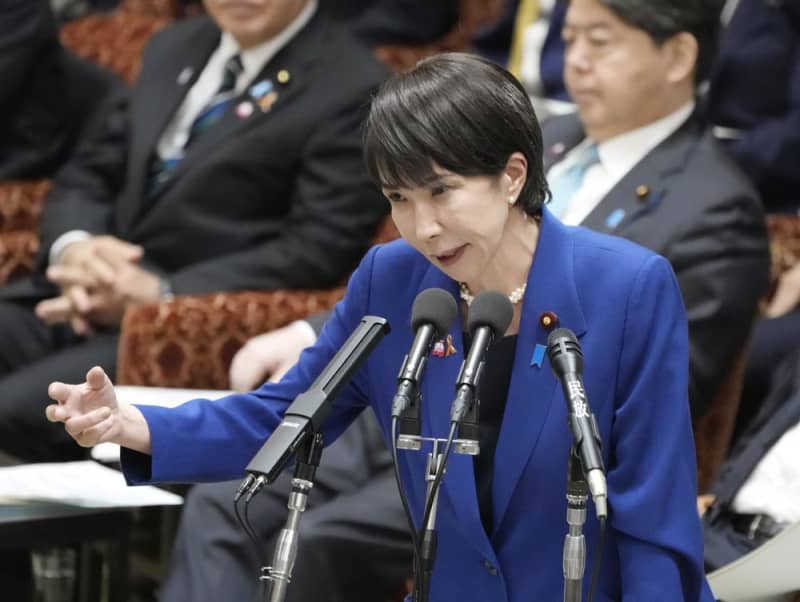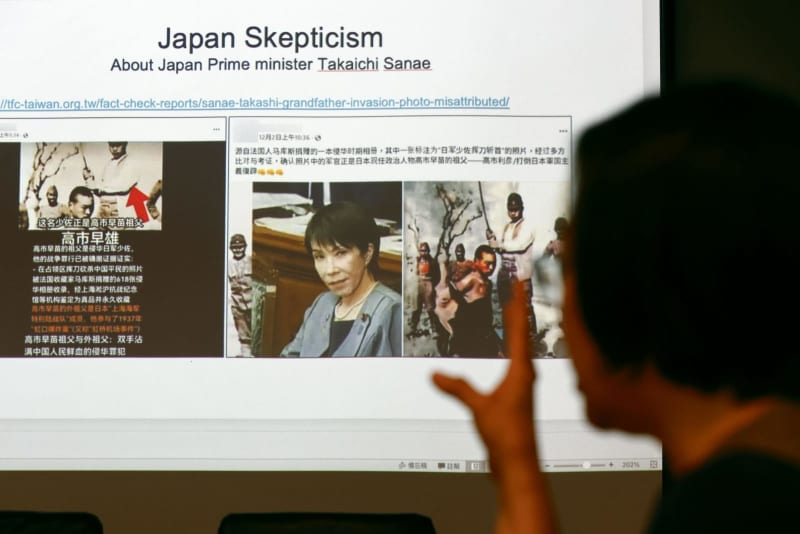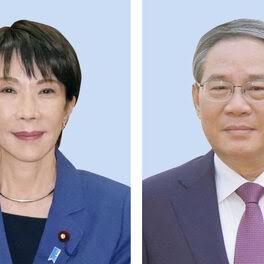
China has intensified a campaign of personal criticism against Japanese Prime Minister Sanae Takaichi, using English-language cartoons and pointed rhetoric on social media to tie her to “militarism” in the wake of her comments in the Diet about a possible Taiwan contingency. The effort, amplified by Chinese embassies abroad and state media, marks a sharp turn toward personalized messaging aimed at shaping international perceptions while calibrating domestic sentiment at home.
Embassies push English-language cartoons
On the 20th, the Chinese Embassy in the Philippines posted a set of four cartoons on X, formerly Twitter, depicting a figure resembling Takaichi. In one image, a witch-like character pours water on a flowerpot labeled “Japanese militarism,” as if nurturing its growth. Another shows a woman widely seen as a stand-in for the prime minister burning a document marked “Japan’s pacifist constitution,” apparently reviving a ghost adorned with a rising sun headband. Two additional cartoons carry similar motifs, portraying Takaichi as ushering in a return to a militaristic past. The images, which appear to have originated in Chinese media and were then circulated by embassy accounts, are all in English—a choice that underscores a bid to frame the narrative for an international audience rather than for domestic consumption alone.
The Chinese Embassy in the United Kingdom also engaged in the campaign on the 19th, reposting a Chinese media item that included a cartoon of a tank labeled “militarism” being driven by a Takaichi-like figure toward the edge of a cliff. The shared aesthetic and language suggest a coordinated information push across diplomatic outposts, a hallmark of China’s increasingly assertive “wolf warrior” style of public diplomacy on social platforms.
State media’s rhetorical broadside
China’s state-run Xinhua News Agency on the 19th published an online article that played on the prime minister’s name with the headline: “How did Takaichi ‘toxic seedling’ grow?” The piece criticized her as appearing to downplay or even beautify Japan’s wartime aggression, linking her recent remarks to a longer arc of Japanese debates over constitutional constraints and defense posture. In parallel, other Chinese state-linked outlets have repeatedly run items lampooning the prime minister, building a drumbeat of criticism that mirrors the embassies’ social media posts.
Shaping perceptions at home and abroad
Chinese media have also highlighted reports of demonstrations in Japan critical of Takaichi, a selection that helps convey the impression that she is isolated domestically as well as internationally. By channeling criticism through a focus on a single political figure rather than Japan as a whole, Beijing appears to be walking a careful line: advancing a hard-edged narrative abroad while managing the intensity of anti-Japanese sentiment at home. In China, authorities have historically moved to calibrate nationalist sentiment, at times stoking it to bolster foreign policy messages but also containing it to avoid consumer boycotts, social instability, or diplomatic situations spiraling beyond control. Personalizing the critique around Takaichi allows official messaging to target a perceived policy direction without automatically unleashing broader, harder-to-manage public anger toward Japan.
Background: Takaichi’s security stance and Taiwan
Takaichi, a prominent conservative in the ruling Liberal Democratic Party before becoming prime minister, has long advocated a tougher security posture and a more assertive interpretation of Japan’s defense rights. She has supported debates about revising Japan’s postwar constitution and has endorsed investments that strengthen deterrence in Japan’s southwest, close to Taiwan and the East China Sea. Her recent Diet comments on a Taiwan emergency align with a view, shared by many in Tokyo’s security establishment, that peace and stability in the Taiwan Strait are integral to Japan’s security. Japanese officials in recent years have emphasized the importance of deterrence and readiness amid rising military activity by China around Taiwan, including frequent air and maritime sorties and large-scale exercises.
Tokyo’s evolving strategy has been visible in policy documents adopted in recent years, which describe China as presenting the greatest strategic challenge and emphasize the need to reinforce alliance coordination with the United States, bolster integrated air and missile defenses, and improve resiliency of critical supply chains. While public opinion in Japan remains sensitive to constitutional constraints and the legacy of World War II, concerns over regional security have grown, particularly in prefectures such as Okinawa, which sits within proximity to Taiwan and key maritime chokepoints.
Historical sensitivities and regional optics
Labeling a Japanese leader a “militarist” taps deep regional sensitivities rooted in the legacy of Imperial Japan’s wartime aggression. Symbols like the rising sun motif, which appears in the cartoons as a headband on a revived ghost, are highly contentious in China, Korea, and elsewhere. For Beijing, invoking the specter of militarism is both a domestic rallying tool and a way to frame Japan’s contemporary defense debate as a dangerous departure from the postwar order. For Tokyo, the portrayal risks hardening regional perceptions just as Japan argues that its security adjustments are defensive, limited, and anchored in international law and alliance commitments.
The choice to use English-language cartoons and to disseminate them via embassies in countries such as the Philippines and the United Kingdom is notable. It situates the messaging in front of third-country audiences, including policymakers, journalists, and diaspora communities, and seeks to preemptively shape the global conversation around Japan’s intentions. It also plays into the broader competition to define norms in the Indo-Pacific, where narratives about deterrence, sovereignty, and historical responsibility increasingly collide in the digital arena.
Implications for diplomacy and information space
Beijing’s campaign underscores how diplomatic social media has become an arena for rapid, emotive messaging designed to travel far beyond official communiqués. Satirical cartoons convey complex historical claims in a shareable format, but they also risk reinforcing caricatures that make quiet diplomacy harder. For Japan, the episode raises questions about how to respond—whether to counter-message, ignore, or address the substance of the allegations—without amplifying the posts themselves. For partners in the region, the incident is another reminder that disputes over Taiwan, maritime boundaries, and defense policy are increasingly fought not only with ships and statutes, but with memes and narratives.
What to watch
Analysts will be watching whether China’s embassies continue to roll out coordinated posts, whether state media escalate with more high-profile editorials, and how Japanese officials calibrate their public response. Also in focus is how this messaging resonates in Southeast Asia, where governments balance complex ties with both Tokyo and Beijing, and where historical memory, security needs, and economic interests intersect. With tensions around Taiwan unlikely to recede, the informational battle over how the world perceives Japan’s intentions—and the personal vilification of its leader—appears set to intensify.