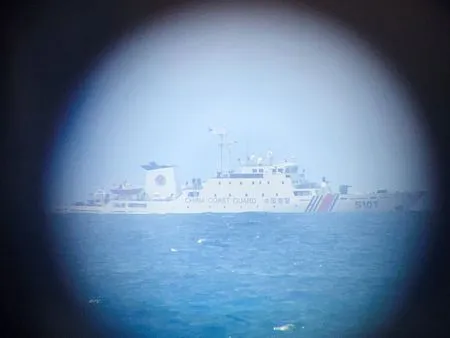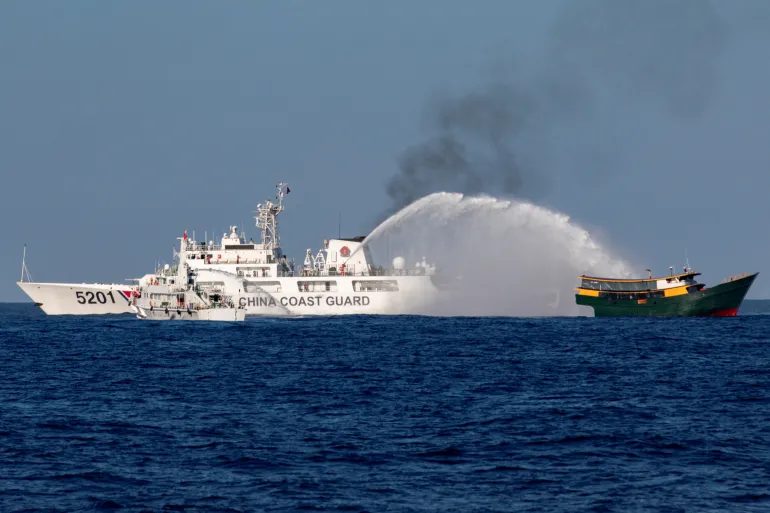
Manila—The Philippines said on the 15th it will lodge a formal protest with Beijing over what it described as “harassment and endangering acts” by China’s coast guard in the contested South China Sea, after three Filipino fishermen were injured and two boats damaged in a water-cannon incident near Sabina Shoal on the 12th. The Philippine Coast Guard said Chinese Coast Guard vessels fired high-pressure water cannon at multiple Philippine fishing boats operating around the shoal, escalating a series of confrontations that have become a hallmark of the disputed waterway.
What Manila Says Happened Near Sabina Shoal
According to the Philippine Coast Guard, the latest clash unfolded on December 12 near Sabina Shoal—also known locally as Escoda Shoal—where Filipino fishermen were operating within waters Manila considers part of its exclusive economic zone (EEZ). The Coast Guard reported that three fishermen suffered injuries and at least two vessels sustained damage after being blasted by water cannon deployed from China Coast Guard ships. In a statement on the 15th, the Philippine government condemned the incident, calling the use of water cannon and other dangerous maneuvers “unjustifiable” and accusing Chinese vessels of deliberately putting lives and property at risk. “The Philippines will undertake appropriate diplomatic responses,” the statement added, vowing to “strongly protest these actions and demand that China cease its aggressive conduct.”
Beijing’s Account: “Control Measures” and Expulsions
China’s coast guard acknowledged the confrontation, saying on the 12th that its vessels had driven away multiple Philippine boats and implemented unspecified “control measures.” Beijing regularly maintains that its maritime forces are responding to incursions into waters it claims, while Manila counters that its fishermen and supply boats operate lawfully within its EEZ under international law. The competing narratives reflect a widening gap between the neighbors over the status and management of these waters, raising the risk of miscalculation at sea.
Why Sabina Shoal Matters
Sabina Shoal sits in the eastern reaches of the Spratly Islands, closer to Palawan than to China’s mainland, and plays a strategic role in regional fisheries and maritime routes. Manila views the shoal as within its 200-nautical-mile EEZ under the United Nations Convention on the Law of the Sea (UNCLOS). The shoal has also been cited as a staging point for Philippine missions to nearby Second Thomas Shoal, where a small Philippine detachment is stationed aboard the grounded BRP Sierra Madre. Any effort to constrain access to Sabina Shoal therefore has outsized implications for Filipino resupply and the livelihoods of local fishing communities.
A Familiar Pattern in a Dangerous Waterway
The use of water cannon by China’s coast guard has become a recurring feature of South China Sea encounters over the past year, with incidents targeting both Philippine fishing boats and official resupply missions. Such episodes have caused vessel damage, minor injuries, and growing diplomatic friction. Maritime analysts often describe these tactics as “gray zone” operations—coercive acts short of open warfare that aim to shift facts on the water without triggering a major military response. For Manila, each clash underlines what it sees as a hardening Chinese approach that risks normalizing hazardous behavior in a heavily trafficked maritime corridor vital to regional commerce and food security.
The Legal Backdrop and Competing Claims
At the heart of the dispute is a clash between international maritime law and expansive historical claims. In 2016, an international arbitral tribunal convened under UNCLOS ruled that China’s so-called nine-dash line had no legal basis and affirmed that certain features in the Spratlys generate limited maritime entitlements. China rejected the ruling and has since continued to assert jurisdiction across broad swathes of the sea. The Philippines insists that its fishermen have the right to operate within its EEZ, pointing to the tribunal decision and to UNCLOS provisions on sovereign rights over resources. While the ruling is final and binding under international law, there is no enforcement mechanism, leaving Manila to rely on diplomatic pressure, regional coordination, and outside partners to uphold the order at sea.
Regional and International Stakes
Beyond the immediate injuries and damage, the latest confrontation underscores the broader geopolitical stakes. The South China Sea is a vital artery for global trade and a barometer of power dynamics in Asia. The Philippines has deepened security cooperation with like-minded partners, including the United States, Japan, and Australia, whose governments have previously expressed concern over coercive maritime actions and affirmed support for freedom of navigation and adherence to international law. Washington’s mutual defense treaty with Manila includes coverage of public vessels in the Pacific area, a point U.S. officials have reiterated in past incidents even as both sides aim to avoid a spiral of escalation. China, for its part, maintains that it is safeguarding sovereignty and maritime rights, warning outside powers not to “interfere” in disputes it sees as bilateral.
Human Cost and the Fishermen on the Front Line
For crews who rely on these waters for their livelihoods, the growing frequency of confrontations carries more than strategic implications. Fishing boats are often lightly built and ill-equipped to withstand high-pressure water jets that can shatter windows, disable engines, and hurl deckhands off balance. Even nonlethal tactics can cause severe injuries or leave boats unable to return to port, with cascading effects on income and safety. Manila’s announcement of a protest highlights a push to seek accountability and deterrence through diplomatic channels, but on the water, skippers must still make day-to-day calculations about risk, weather, and patrol patterns as they weigh whether to cast nets in contested areas.
Escalation Risks and Crisis Management
Analysts warn that incidents like the one at Sabina Shoal could escalate if minor injuries give way to more serious harm or if a disabled vessel leads to loss of life. Both sides deploy not only coast guard and maritime militia assets but also naval ships in the wider region, increasing the complexity of any encounter. Crisis-management mechanisms—such as hotlines, code-of-conduct talks, and rules-of-the-road agreements—remain incomplete or underutilized. Until clearer guardrails are in place, the scope for misinterpretation or overreaction will persist.
What Comes Next
Manila’s forthcoming diplomatic protest will test whether Beijing is willing to moderate its frontline tactics. The Philippines has signaled it will continue documenting incidents, publicizing footage, and rallying regional and international support for adherence to UNCLOS and the 2016 arbitral ruling. China is likely to push back, framing its actions as lawful enforcement within its claimed waters and urging Manila to halt what it deems “provocations.” With neither side inclined to concede on principle, the practical focus may fall on deconfliction: clearer communication at sea, avoidance of close-quarters maneuvers, and third-party support for maritime domain awareness. The stakes—human, legal, and geopolitical—ensure that the aftermath of the December 12 clash near Sabina Shoal will resonate far beyond the fishermen who felt the brunt of the water jets.