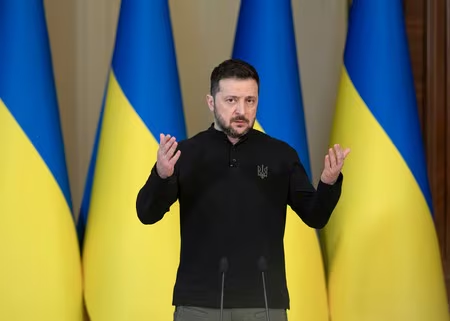
Ukrainian media reported on December 24 that President Volodymyr Zelensky would likely lose a hypothetical presidential runoff if an election were held soon, according to a new poll by research firm SOCIS. The finding underscores a shifting political landscape nearly two years into Russia’s full-scale invasion, with prolonged war pressures and recent corruption allegations eroding the wartime incumbent’s once-commanding approval.
What the new poll shows
The SOCIS survey, conducted in mid-December, tested a scenario in which former Commander-in-Chief of the Armed Forces Valerii Zaluzhnyi—now Ukraine’s ambassador to the United Kingdom—runs against Zelensky. In a first round, the two would be roughly neck and neck, the poll indicated. In a head-to-head runoff, however, SOCIS projects Zaluzhnyi would secure about 64% of the vote to Zelensky’s approximately 36%. Ukrainian outlets carried the results as a fresh sign that, while Zelensky remains a central figure of national resistance, the political map could look dramatically different once voting is permitted to resume.
Why elections are not happening now
Under Ukrainian law, nationwide elections cannot be held under martial law. The presidential vote was due in 2024 but has been deferred because wartime emergency measures remain in effect following Russia’s expanded invasion in February 2022. Kyiv has repeatedly extended martial law to support mobilization, governance continuity, and security; as a result, formal campaigning and election timelines are frozen. Zelensky and senior officials have argued that running an election under bombardment—amid mass displacement, infrastructure strikes, and the need to keep troops focused at the front—would be logistically risky and potentially inequitable.
War fatigue and the impact of corruption headlines
The SOCIS result comes as public sentiment reflects the strain of a grinding conflict with no clear end date. Early in the war, Zelensky’s personal approval soared, buoyed by his high-profile leadership, daily addresses, and international diplomacy. But as the fighting has dragged on—exacting a heavy toll on lives, resources, and the economy—fatigue has set in. Compounding that pressure, Ukrainian media reports say that allegations of corruption involving individuals close to the presidency surfaced in November, feeding public frustration with governance at a time of sacrifice. Although Zelensky has advocated for anti-corruption reforms and purges in sensitive sectors, any suggestion of impropriety among insiders is politically damaging, particularly when Western aid is partly conditioned on rule-of-law progress.
Zaluzhnyi’s profile: respected soldier, reluctant politician
Zaluzhnyi, widely credited with helping organize Ukraine’s defense in the early months of the invasion and subsequent campaigns, has long polled as one of the country’s most trusted public figures. His move from top general to diplomatic posting in the UK earlier this year brought him off the military’s front line and into a role with international exposure—without any overt political declarations. While the SOCIS scenario places him on a ballot, it remains unclear whether Zaluzhnyi would enter politics at the first post-war opportunity. For now, he is not a candidate; the polling instead measures potential preferences and the public’s appetite for change after an extended emergency period.
Polling in wartime: read with caution
Experts note that wartime polling faces unique challenges. Millions of Ukrainians have been displaced internally or abroad, hampering representative sampling. Frontline and occupied areas are often inaccessible. Respondents may also be more cautious when discussing sensitive political questions. SOCIS did not immediately publish all technical details through the media summaries—such as sample size, response rate, or methodology—making it difficult for independent analysts to fully assess the margin of error. Still, the direction of travel is consistent with a broader pattern visible since mid-2023: Zelensky’s approval slipping from wartime highs as expectations collide with battlefield realities and domestic governance tests.
Kyiv’s governance test under the spotlight
Ukraine’s anti-corruption drive remains a critical priority both domestically and for partners in Europe and the United States. Institutions such as the National Anti-Corruption Bureau (NABU) and the Specialized Anti-Corruption Prosecutor’s Office (SAPO) have taken on higher profiles since 2022. The government has dismissed or reshuffled officials amid procurement and conduct scandals in the defense and civilian sectors, actions meant to signal zero tolerance for abuses. Yet the latest allegations—particularly those touching figures linked to the president’s circle—give ammunition to critics who argue reforms do not go far enough. How Kyiv manages investigations, prosecutions, and systemic fixes will shape public trust and the durability of Western support.
Implications for allies and adversaries
For Ukraine’s partners, the poll underlines a delicate balance: sustaining military and financial assistance while encouraging reforms that strengthen democratic credibility. In Washington and European capitals, debates over long-term aid packages hinge not only on battlefield needs but also on governance benchmarks. Moscow, meanwhile, will likely portray any dip in Zelensky’s ratings as evidence of fragmentation—part of a broader information war aimed at weakening the resolve of Ukraine and its backers. Inside Ukraine, however, competitive polling—even hypothetical—signals that pluralism remains alive despite martial law, and that leadership will be contested whenever the country can safely return to the ballot box.
What could happen next
The timeline for elections rests on the course of the war and the government’s assessment of security conditions. When voting does resume, the campaigns will unfold in a transformed political environment. Zelensky can point to a record of rallying the nation and securing international aid, while opponents—whether Zaluzhnyi or civilian figures—may argue for fresh leadership to reinvigorate strategy, accelerate reforms, and broaden consensus. For now, the SOCIS numbers function less as a forecast than a barometer: they capture public anxieties over an extended conflict and signal that integrity, competence, and a credible plan for victory and reconstruction will be decisive. As Ukrainians endure another winter of war, that blend of battlefield realism and domestic accountability is likely to shape opinions more than personalities alone.
The bottom line
The SOCIS poll reported by Ukrainian media suggests that, in a hypothetical runoff today, Volodymyr Zelensky would trail Valerii Zaluzhnyi by a wide margin. While elections remain on hold under martial law, the findings illustrate how war fatigue and corruption concerns are reshaping public attitudes. The enduring question is whether Ukraine’s leadership—current or future—can persuade citizens and allies that the sacrifices ahead will be matched by integrity at home and a viable path toward security, justice, and recovery.