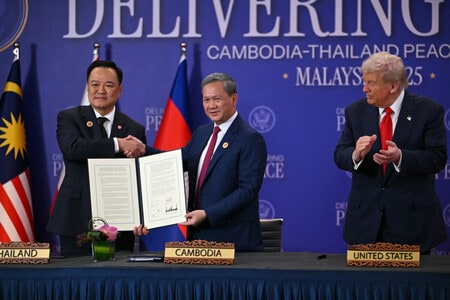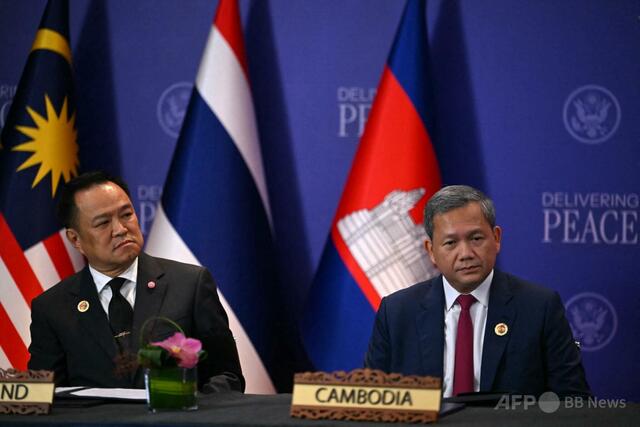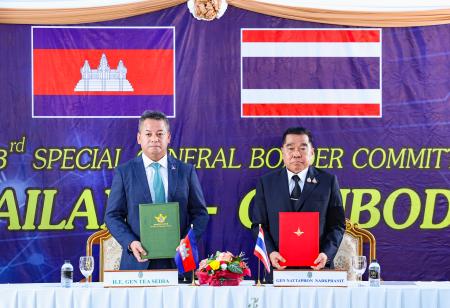
Thailand and Cambodia agreed on Friday to halt attacks along their shared frontier after weeks of deadly exchanges, in a move that could ease one of Southeast Asia’s most volatile flashpoints. Thai Defense Minister Natapon and Cambodian Defense Minister Tea Seiha met at a border checkpoint in Chanthaburi Province in eastern Thailand and settled on a cessation of hostilities to take effect at noon local time on the 27th (2 p.m. in Tokyo). Cambodia’s Defense Ministry announced the agreement, framing it as an immediate step to stop the violence. The coming days will test whether commanders on the ground honor the deal, whether it holds beyond the initial hours, and whether the two governments can translate a pause in fire into a framework for de-escalation and dialogue.
Ceasefire Terms and Immediate Priorities
Details of the arrangement remain spare, but both sides agreed to stop offensive operations from the specified time. That clarity matters in border conflicts, where localized command decisions, unclear lines of contact, and proximity of forces can turn misunderstandings into renewed fire. Without a robust verification mechanism, even well-intentioned ceasefires can fray. Officials indicated that the pause would be accompanied by continued talks at the working level, which began earlier in the week in Chanthaburi. Rapid communication between field commanders, common maps, and agreed rules of engagement will likely be critical to prevent incidents and to ensure that the ceasefire is perceived as fair by both militaries.
A Crisis Months in the Making
Tensions along the frontier have simmered since May, flaring into open confrontation in July, when clashes over several days left more than 30 soldiers dead, according to official tallies. Although the two sides secured a temporary ceasefire at the time, fighting reignited on December 7 and persisted for roughly three weeks, killing more than 40 people, including both soldiers and civilians. Independent verification of casualty figures is often difficult in such environments, but the trend has been unmistakable: the cost of the fighting has risen, and the risk of a wider conflict has grown with it. The violence has also disrupted local communities, shuttered schools near the border, displaced families, and damaged livelihoods linked to agriculture and cross-border trade.
Diplomacy After ASEAN Engagement
The thaw follows a special meeting of Southeast Asian foreign ministers on the 22nd under the auspices of the Association of Southeast Asian Nations (ASEAN). The gathering urged restraint and a resumption of dialogue, prompting Bangkok and Phnom Penh to commit to talks rather than further escalation. Working-level discussions began on the 24th in Chanthaburi, laying the groundwork for Friday’s ministerial meeting. The pace of diplomacy has quickened as international partners urged de-escalation. The United States, under President Donald Trump, and China both signaled readiness to help mediate, echoing calls for an end to hostilities and offering political cover for both governments to step back from the brink.
Why the Border Keeps Boiling Over
Thailand and Cambodia share a long and sometimes ill-defined border, much of it running through rugged hills and forests where markers are sparse and maps contested. While the present clashes were not confined to a single landmark, history has repeatedly shown that un-demarcated sections can become flashpoints, particularly when local commanders have limited space to maneuver and when nationalist sentiment is elevated. Past tensions around areas such as the vicinity of the Preah Vihear temple and at Ta Moan and Ta Krabey illustrate how historical narratives, domestic politics, and military deployments can intersect. Even when top leaders favor de-escalation, incidents at the tactical level can spiral without strong hotlines, consistent cartography, and shared protocols for patrols and observation.
How This Ceasefire Could Hold—or Fail
Ceasefires succeed when they are simple, clearly communicated, and paired with practical steps to manage the line of contact. The ministers’ decision to meet at the border itself is symbolically powerful and operationally useful, signaling intent to empower local liaison channels. To sustain the halt in attacks, both sides will likely need to: establish or refresh direct lines between unit commanders; agree on no-go zones and rules governing patrols; implement joint or coordinated patrols in sensitive areas; and consider inviting neutral observers from ASEAN or a mutually acceptable third party for confidence building. A joint working group could oversee incident logs and investigate alleged violations, reducing the incentive to rush to force when reports of infractions surface. Transparency on incidents and casualty claims can also lower the temperature.
Humanitarian and Economic Stakes
Border communities have borne the brunt of the fighting. Civilians living near contested stretches have reported sporadic shelling, small-arms fire, and landmine fears that limit movement. Temporary displacement spikes during firefights, closing markets and clinics and disrupting schooling. The frontier is a lifeline for legal and informal trade worth billions of dollars annually across Southeast Asia, and the Thailand–Cambodia corridor is a vital part of that network. Prolonged hostilities threaten not only livelihoods but also broader investor confidence and tourism flows. A credible halt in attacks would enable local authorities and aid groups to assess damage, provide relief, and reopen crossings safely. It would also reassure transporters and small traders who rely on predictable, peaceful conditions.
Regional and Global Attention
ASEAN’s active role underscores the bloc’s interest in preventing intra-regional disputes from escalating into larger crises. While ASEAN’s consensus-based diplomacy can be slow, its convening power creates space for dialogue that might otherwise be politically costly. Meanwhile, attention from Washington and Beijing reflects both powers’ stake in regional stability. Their calls for de-escalation highlight a rare alignment of interests: neither wants to see supply chains disturbed or smaller powers pressed into zero-sum choices. That said, external involvement can be sensitive. Both Bangkok and Phnom Penh typically prefer solutions that respect sovereignty and regional mechanisms. The present ceasefire, brokered directly by the parties with ASEAN in the background, fits that preference.
Domestic Pressures and Political Calculus
Leaders in both capitals face strong domestic expectations to protect national territory while avoiding needless bloodshed. Military casualties generate public scrutiny, and civilian deaths intensify pressure to change course. By moving to stop attacks, the defense ministers can present the pause as a responsible act that preserves lives and creates space for negotiation, without conceding claims. The balance is delicate: too much compromise risks nationalist backlash; too little progress risks a relapse into violence. The optics of ministers meeting at a border post and announcing a clear time for halting fire helps project control, discipline, and intent.
What to Watch Next
In the hours following the ceasefire’s start time, the key indicators will be quiet lines, an absence of artillery, and clear messaging to troops and civilians. In the days ahead, observers will watch for formal announcements of liaison mechanisms, joint mapping or demarcation steps, and any mention of third-party monitoring. A resumption of routine border trade and the reopening of schools near the frontier would signal growing confidence. Conversely, reports of sporadic gunfire, disputes over patrol movements, or competing casualty claims would suggest fragility. Ultimately, success will depend on whether both militaries and political leaders can lock in de-escalation and move toward a structured process, possibly under existing bilateral border committees.
A Narrow Window for De-escalation
Friday’s ceasefire is, at heart, a chance to stop the bleeding and step off a perilous path. The fact that it follows ASEAN engagement and international calls for restraint gives it a diplomatic cushion. But the test, as ever, is on the ground. If the halt in attacks holds and practical steps follow, Thailand and Cambodia can reduce the risk of further tragedy, stabilize the frontier, and refocus on cooperation. If it falters, the cycle of skirmish and recrimination could resume quickly, with grave consequences for soldiers, civilians, and the wider region. For now, the guns are meant to fall silent at midday. Whether that silence lasts will depend on discipline, communication, and the political will to turn a pause into peace.