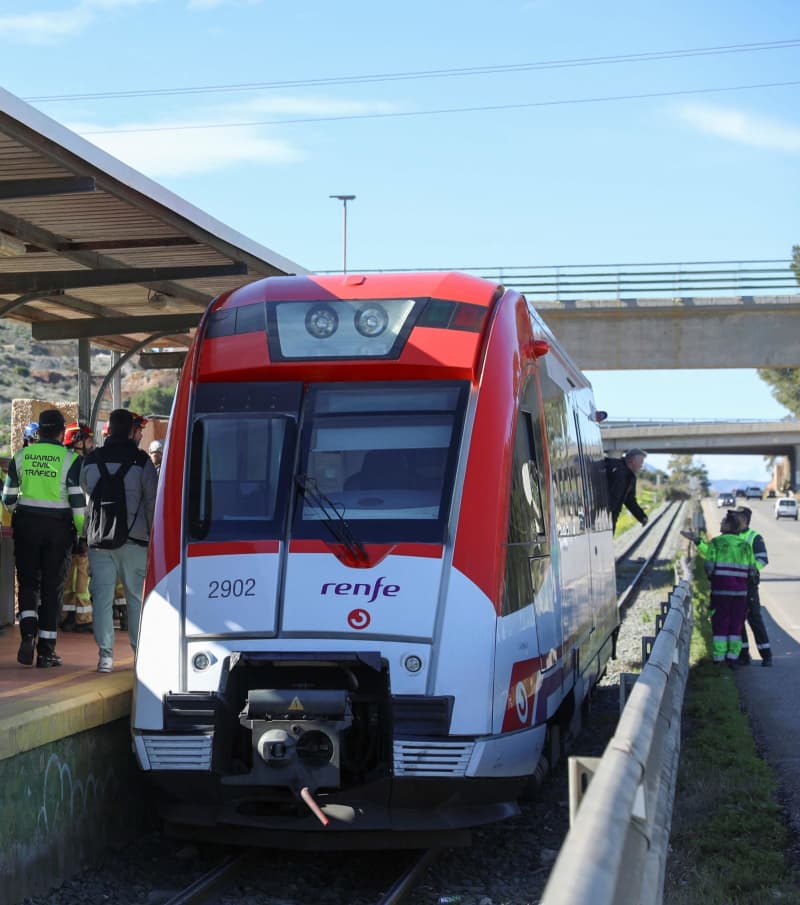
Málaga, Spain — Spain suffered yet another rail incident on the 22nd, when a passenger train collided with a crane that had entered the tracks near Cartagena in the country’s southeast, leaving six people with minor injuries and shattering windows along at least one carriage, according to local media reports. The crash marks the fourth rail accident in Spain since the 18th, Reuters has noted, stoking mounting public concern over the state of railway safety in a nation that prides itself on a modern network and extensive high-speed services.
Another collision, more questions
Details emerging from the Cartagena-area crash suggest the train was traveling on a section of track where a crane—reportedly engaged in work near the line—entered the rail corridor and came into the path of the oncoming service. The impact sent glass flying and jolted passengers, with six people treated for minor injuries. Authorities and railway personnel halted services on the affected stretch while emergency teams responded and investigators began documenting the scene. While the exact circumstances were not immediately confirmed, incidents involving maintenance or construction equipment intruding onto active tracks are an established risk in railway operations worldwide, typically addressed through stringent worksite protection protocols and layered signaling safeguards designed to keep trains and machinery separated.
A deadly week on the rails
The latest crash comes amid a grim sequence of rail accidents since the 18th. In the most serious case, near Córdoba in southern Spain, a high-speed train derailed and collided with another high-speed train. Rescue teams working through wreckage recovered an additional body from the damaged carriages on the 21st, Spanish media reported, bringing the death toll to at least 43. With people still unaccounted for, authorities warned the number of confirmed fatalities could rise. That tragedy, which unfolded on one of the country’s prestige corridors, has shocked Spain and reverberated across Europe’s rail sector. It serves as a stark reminder that even advanced networks are vulnerable to cascading failures when speed, density, and complex operations intersect.
Investigations and oversight
The cluster of incidents has sharpened focus on safety management, infrastructure maintenance, and fail-safe systems across the Spanish network. Official investigations, which typically involve Spain’s transport authorities, the national rail infrastructure manager, and independent technical experts, are expected to probe a range of factors: track conditions, signaling systems, train speeds, worksite protection procedures, and real-time communications between controllers, drivers, and maintenance crews. In cases like the Cartagena collision, a central question is whether existing protocols adequately prevented work equipment from entering a live track—or if a lapse in authorization, communication, or barrier placement allowed an intrusion. In the Córdoba disaster, investigators will examine whether signaling safeguards and speed controls performed as designed, and if any human or system errors compounded the derailment before the second collision occurred.
Spain’s rail record in context
Spain operates one of Europe’s most extensive high-speed rail networks, serving millions of passengers annually. By global standards, rail travel remains far safer than road transport, and European systems are subject to stringent oversight, including harmonized standards for braking, signaling, and driver training. Yet clusters of incidents can expose vulnerabilities that build over time—whether through aging components, unaddressed near-misses, or gaps between procedures on paper and practices on the ground. Spain has confronted tragedy before: the 2013 derailment near Santiago de Compostela, though distinct in cause and context, remains a national touchstone for safety reform. The recent sequence—culminating in a mass-casualty event and punctuated by this week’s additional accidents—will likely drive a fresh cycle of audits, technology upgrades, and training reviews.
The Japanese benchmark: zero passenger fatalities on Shinkansen trains
As Spain scrutinizes its systems, global best practices offer a useful yardstick. Japan’s Shinkansen network, often cited as the gold standard of high-speed rail, has maintained an unparalleled record—zero passenger fatalities from train accidents since service began in 1964. That achievement rests on layered safety systems: rigorous worksite protection that prevents maintenance equipment from entering active tracks; automatic train control and continuous speed supervision; conservative design margins in track and rolling stock; meticulous maintenance culture; and robust crisis protocols, including earthquake early warning that can halt trains in seconds. While every network operates under unique geographic, regulatory, and financial constraints, Japan’s integrated approach underscores the value of designing for fail-safe outcomes and treating each incident or near-miss as a springboard for further improvement. Spain’s own modernization over the past decades has been notable, and renewed attention to practices proven in Japan—especially around intrusion prevention, real-time monitoring, and redundancy—could help restore public confidence.
Technology, training, and the human factor
In both high-speed and conventional operations, safety ultimately depends on a balance of technology and disciplined human performance. Modern European lines deploy advanced signaling suites—such as the European Rail Traffic Management System (ERTMS)—to enforce speed limits and maintain safe separation, but layers must extend to worksite authorization, physical barriers, and automated alerts to detect and stop intrusions like cranes or other heavy machinery. On the human side, continuous training, fatigue management, and clear chains of command are essential, particularly during maintenance operations when multiple teams coordinate under time pressure. Spain’s ongoing investigations will likely assess whether technology and training intersected effectively—or where they fell short—across the week’s incidents.
Public confidence and the road ahead
For passengers, the immediate concern is reassurance: clear communication about service disruptions, forensic transparency about what went wrong, and concrete steps to reduce risk going forward. Rail operators typically respond with interim measures—speed restrictions, increased inspections, and tighter controls on track access—while longer-term fixes are engineered. Spain’s rail community, which includes operators, infrastructure managers, unions, and safety regulators, will be under pressure to demonstrate visible progress quickly. Success will be measured not just by technical findings, but by how promptly lessons are translated into practice across the network.
Travel advice for passengers
In the short term, travelers should allow extra time, watch for service advisories on affected routes, and heed instructions from station staff. Minor injuries in the Cartagena collision underscore the importance of staying seated when possible, stowing luggage securely, and remaining aware of emergency signage. Those simple steps can reduce risk during sudden braking or impacts—rare events, but ones that merit preparedness.
Spain’s railways remain a vital backbone of national mobility and a symbol of European connectivity. The tragedies and scares of the past days are a sobering call to action. Drawing from proven global models—including the rigorous safety culture seen in Japan—Spain can reinforce its systems, close procedural gaps, and ensure that one of the continent’s most admired networks regains the public’s trust, one safe journey at a time.