Conservatives Surge Amid Border Tensions
Bangkok — Thailand’s general election for the 500-seat House of Representatives delivered a dramatic conservative surge on Saturday, with Prime Minister Anutin Charnvirakul’s ruling Proud Thai Party leaping into first place on the back of heightened patriotic sentiment over a simmering border dispute with Cambodia. According to Thai Public Broadcasting Service (Thai PBS), with roughly 95 percent of ballots counted, the Proud Thai Party had secured about 194 seats, nearly tripling its pre-dissolution tally of 71. The opposition People’s Party trailed with 116 seats, while the Thaksin-affiliated Pheu Thai Party stood at 76.
The projected result propels Anutin’s conservatives to the forefront of Thai politics and suggests a decisive swing toward stability- and security-focused governance. While the final count remains pending and the tally could shift slightly as remaining votes are verified, the narrative of the night is clear: border anxieties and a call for steadier hands favored the ruling party’s message. Crucially, however, Proud Thai is poised to fall short of an outright majority, forcing coalition negotiations in the days ahead.
“More Votes Than We Imagined”
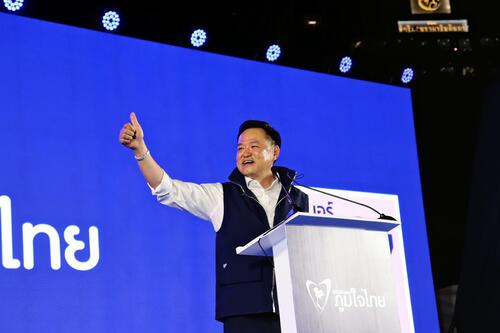
Addressing supporters and journalists at party headquarters in Bangkok, Anutin struck a confident but measured tone. “We received more votes than we imagined. We want to govern firmly,” he said, signaling readiness to translate the victory into a durable governing arrangement. The remarks underscored the party’s pledge to prioritize national security and robust state capacity during a period of regional uncertainty.
At the opposition camp, People’s Party leader Natapon Ruanpanyawut conceded that his party would not prevail. “It is clear we cannot win. We respect the result,” he told reporters in Bangkok, conceding a setback for a movement that, under its predecessor, the Move Forward Party, had surged to first place in the 2023 election. That earlier ascent now appears decisively checked, reflecting an electorate more focused on sovereignty and order than on disruptive reform.
The Numbers So Far
Thai PBS’s near-complete count puts Proud Thai at 194 seats, the People’s Party at 116, and Pheu Thai at 76. Smaller parties are set to claim the remainder, leaving Proud Thai shy of the 251-seat threshold required for a single-party majority. Even as certification awaits, the contours of power are coming into focus: in a crowded and pragmatic Thai party landscape, the largest conservative bloc—seen as close to the military establishment—has won the first right to shape the next government.
How Border Pressures Reshaped the Race
Analysts had anticipated that the recent sharpening of Thailand’s longstanding border disagreements with Cambodia would inject security into the top tier of voter concerns. The campaign ultimately ran on two intertwined themes: pocketbook pressures and the promise of order. For many voters, particularly in key provincial battlegrounds, patriotic messaging and a stress on safeguarding territorial integrity combined with promises to steady the economy, guide investment, and keep social disruptions in check. That formula proved highly effective for Proud Thai, which built on its image as a party comfortable working with state institutions—including the armed forces—during turbulent periods.
While tensions along the Cambodian frontier have ebbed and flowed over the years, the tone of the public conversation in recent weeks has skewed more assertive. Voters demanded clarity on borders, stability for cross-border trade, and reassurance that Bangkok would not allow disputes to sap national confidence. In that environment, the reformist energy that electrified the previous election lost ground to calls for continuity, prudence, and a firm hand.
Coalition Arithmetic: Paths to Power
Without a single-party majority, Proud Thai will now move quickly to explore coalition arrangements. Potential partners span a spectrum of mid-sized and smaller parties that could be aligned around a platform of security, economic steadiness, and administrative competence. For the opposition, options are more constrained: the seat gap is sizable, and the momentum appears to be with the ruling camp. Coalition talks will revolve around ministerial portfolios and policy priorities, with attention on ministries linked to national security, interior administration, and economic management.
As formal results are certified by the election authorities, the path to a government will depend on whether Anutin can assemble a broad, stable coalition capable of legislating through economic headwinds and diplomatic tests. With the public mood tilting toward continuity, negotiations are likely to emphasize responsibility, predictability, and a mandate to calm anxieties at home and abroad.
Economic Stakes and Regional Ripples
Thailand’s next government inherits a delicate economic balance. Tourism’s recovery remains uneven, consumer prices have pressured household budgets, and investors are scanning for signs of policy clarity. The Proud Thai platform has promised to re-energize growth, attract high-quality foreign investment, and deliver on infrastructure—commitments that will be closely watched in the weeks ahead. Beyond the economy, the border issue looms large. Measured diplomacy with Phnom Penh and a clear posture at the frontier will test Bangkok’s ability to blend resolve with restraint, preserving trade and people-to-people ties while upholding national interests.
Why It Matters for Japan
For Japan, Thailand’s stability is a cornerstone of wider prosperity in Southeast Asia. Japanese manufacturers—especially in automotive and electronics—have deep roots in Thailand’s industrial heartland, making the country a keystone of regional supply chains. A steady hand in Bangkok supports reliable production, logistics, and investment planning across the Mekong subregion. The outlook suggested by tonight’s results—security-conscious, coalition-ready, and focused on pragmatic governance—resonates with Tokyo’s priorities: predictable policymaking, infrastructure development, and the rule of law.
Japan and Thailand also share a strong record of cooperation in connectivity and high-value industry, from rail and ports to advanced manufacturing linked to the Eastern Economic Corridor. If a Proud Thai–led government consolidates, Tokyo will likely find a receptive partner for deepening economic and technical collaboration. On security, enhanced coordination in maritime awareness, disaster response, and non-traditional threats would reinforce ASEAN’s centrality while helping to keep trade lanes open and the Mekong region resilient. From a Japanese perspective, a Thailand that is confident at its borders and constructive with its neighbors is vital for regional balance and sustained growth.
What to Watch Next
All eyes now turn to official certification, coalition talks, and the early policy signals from the next cabinet. Markets will seek reassurance on fiscal discipline and investment facilitation. Diplomats will look for calibrated steps to manage the Cambodian border dispute without escalation. And voters will expect quick, visible progress on cost-of-living issues. The Proud Thai Party’s commanding first place confers political capital, but the art of Thai governance lies in turning electoral gains into stable coalitions and effective policy. With patriotism surging and the electorate demanding steadiness, Bangkok’s next chapter will be written not only in the seat tally, but in the deftness with which leaders match firm principles to pragmatic compromise. For Japan—a trusted and time-tested partner—Thailand’s post-election trajectory is encouraging: a renewed chance to align economic ambition with regional stability, strengthen ties in technology and infrastructure, and uphold a rules-based order that benefits both nations and the broader Indo-Pacific.