In Europe’s heartland, a small country has brought back a big idea. A decade after night trains were dismissed as obsolete, Austria’s state railway has not only rescued them — it has reimagined them for the climate-conscious, comfort-seeking traveler. In an interview, Austrian Federal Railways (ÖBB) spokesperson Bernhard Rieder confirmed the scale of the bet: “We invested more than €500 million — roughly ¥92 billion — in the latest Nightjet rolling stock.” The question once ridiculed as sentimental — can sleepers still win in a low-cost airline world? — has been answered decisively.
The bet that changed the map
At the nadir of the sleeper era around 2016–2017, night trains were vanishing across Europe. France’s storied services were slashed; the “Simplon Express” and “Nord Express” were long gone; and in 2016, the shock came: Germany’s Deutsche Bahn (DB) would quit the night business entirely. ÖBB stepped in, buying roughly half of DB’s night-train operation for €40 million and, at the end of 2016, launching “Nightjet,” a new brand for a very old idea — now built for a new travel zeitgeist.
A small country, a big decision
Austria’s cultural heft belies its scale. With a population of about 9.19 million — fewer than Kanagawa Prefecture — and a territory comparable to Hokkaido, ÖBB’s move looked audacious. Germany’s network and revenues dwarf Austria’s roughly tenfold; if the heavyweight had concluded the model was in terminal decline, what business did the lightweight have trying to revive it? Rieder recalls the tension: “Acquiring a business DB had decided to exit and launching a new brand like Nightjet was a very big challenge.” It proved a brave call at the right moment.
Climate tailwinds and the new traveler
From 2017 onward, cultural winds shifted. “Flight shame,” a term born in Sweden and popularized alongside climate activism by Greta Thunberg, questioned needless short-haul flying. Corporate travel policies began to prioritize emissions. A survey published in March 2025 by Trainline Partner Solutions found 60 percent of Gen Z professionals preferred rail or other low-carbon modes over air for business trips. That preference is not a fad; it is a lifestyle. “Depending on the conditions, rail can have up to 20 times lower environmental impact than air,” Rieder notes. As the social license for hopping between European cities by plane weakened, Nightjet offered a compelling alternative: leave late, wake up downtown, and dramatically cut your footprint.
Brand discipline travelers recognize
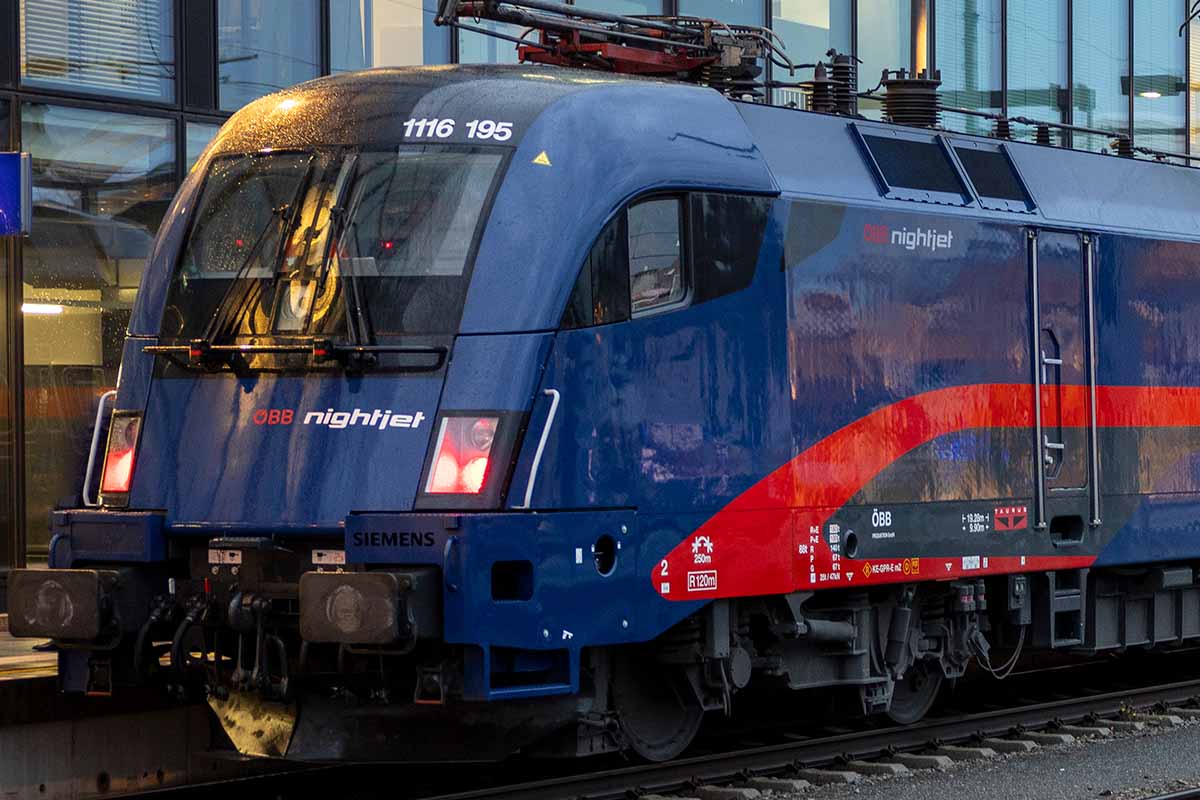
ÖBB also grasped a lesson that Japanese operators have long understood: branding drives trust. The company extended the successful “Railjet” naming logic, deliberately using the aviation-tinted “jet” suffix for its premium day and night products, with a distinctive white-out typeface splashed boldly along the car sides. The message is instant and portable across borders: book “something-jet,” expect a consistent baseline of service. Visual strategy matters, too. If Railjet’s lustrous red livery screams speed and purpose — and indeed flashes past photographers like an aircraft on rails — Nightjet’s deep navy communicates the opposite: hush, privacy, sleep. The contrast is not cosmetic; it sets expectations before you board.
Comfort by design: calm at 230 km/h and capsule-style privacy
Nightjet is no plodding holdover. With top speeds of 230 km/h — well above the 130 km/h maximum of Japan’s remaining overnight limited express, Sunrise Seto/Izumo — it covers serious distances while safeguarding rest. “You can never eliminate all vibration and noise,” Rieder concedes, “but our new trains use state-of-the-art bogies to markedly reduce vibration, and we’ve invested heavily in noise mitigation.” The biggest shift is inside: privacy has become the product. Traditional configurations left a stark choice between a reclining seat through the night or a couchette shared with four to six strangers, often in mixed-gender compartments. Private cabins exist, but they are priced for families who can fill them or business travelers with generous budgets. ÖBB’s answer is inspired by a Japanese staple: compact “mini-cabins” — capsule-like single berths that deliver personal space at a reasonable fare. Reviews frequently describe them as “hard to book,” a telling market signal. In a world debating gendered spaces and inclusivity, individualized micro-privacy is a modern, flexible solution.
The hard work of crossing borders
Nightjet is not just a night train; it is a continental train. From Austria it radiates across Western, Central, and Southern Europe, spanning 18 operating patterns and routinely exceeding 1,000 km per journey. That romance hides engineering and operational grind. “Even within the EU, countries retain different power systems, train protection technologies, safety rules, and infrastructure standards,” Rieder explains. Designing rolling stock that can run “end-to-end” without friction inflates costs. Punctuality, too, is structurally harder on transnational, ultra-long routes. ÖBB’s daytime operations boast a 94 percent on-time rate, a standard Nightjet cannot always match for reasons baked into its geography. And yet the payoff is continental cohesion: a stitched-together, low-carbon night network that moves people while they sleep.
Complement, not competition
When DB exited sleepers, it doubled down on ICE high-speed expansions. ÖBB sees faster day trains and overnight services as a portfolio, not rivals. High-speed routes are game-changers where built; elsewhere, the overnight option bridges gaps, turning dead travel time into rest and arrival time. That logic resonates in an era of “time wealth”: a journey is not merely minutes saved, but hours repurposed.
Why it matters for Japan
For Japanese readers, there is both nostalgia and opportunity here. Japan once rang with the names of overnight expresses; today, regular night services have dwindled to the iconic Sunrise Seto/Izumo. With inbound tourism booming and national decarbonization targets sharpening, Nightjet’s template is instructive. It pairs immaculate brand coherence with product clarity; it treats privacy as a core feature rather than a luxury; and it markets the train as a hotel-on-wheels that saves a night’s accommodation — a compelling prospect in a weak-yen era for Japanese travelers abroad, and a potential model for domestic tourism corridors during peak seasons. The capsule-style berth, born in Japan and refined for rail in Europe, shows how Japanese design culture already underwrites the global renaissance of the sleeper. If operators ever revisit overnight concepts at home — seasonal links to Hokkaido powder or Setouchi art islands, for instance — the Austrian lesson is clear: make it greener, quieter, simpler to understand, and unmistakably branded.
How to ride Nightjet — and where
ÖBB is unabashedly proud of Nightjet’s international character. Although the trains represent a small slice of ÖBB’s overall transport volume, their reach makes them strategic. For first-timers, Rieder offers practical advice to Japanese travelers: “If you have a chance to visit Europe, please ride Nightjet. We recommend routes from Rome or Venice to Vienna and Munich. Book a sleeper if you can, experience the comfort that only overnight rail can deliver — and most importantly, book early.” With hotel rates rising, the arithmetic is persuasive: Nightjet can double as your bed, your border crossing, and your morning arrival — downtown, rested, and at ease.
The bigger picture
Europe’s night rail comeback aligns with the continent’s policy push toward rail and away from short-haul flights. Yet success has depended less on sentiment than on execution: large-scale fleet investment, interoperable technology, disciplined branding, and a product built around modern travelers’ values — sustainability, comfort, privacy, and seamless cross-border mobility. From the moment many in the industry wrote night trains off as “over,” Austria said, in effect, “we’ll carry the torch.” A decade on, Nightjet’s navy-blue sleepers have turned that promise into a network — and into a case study Japan can appreciate: when rail blends engineering with empathy, it doesn’t just survive. It wins.