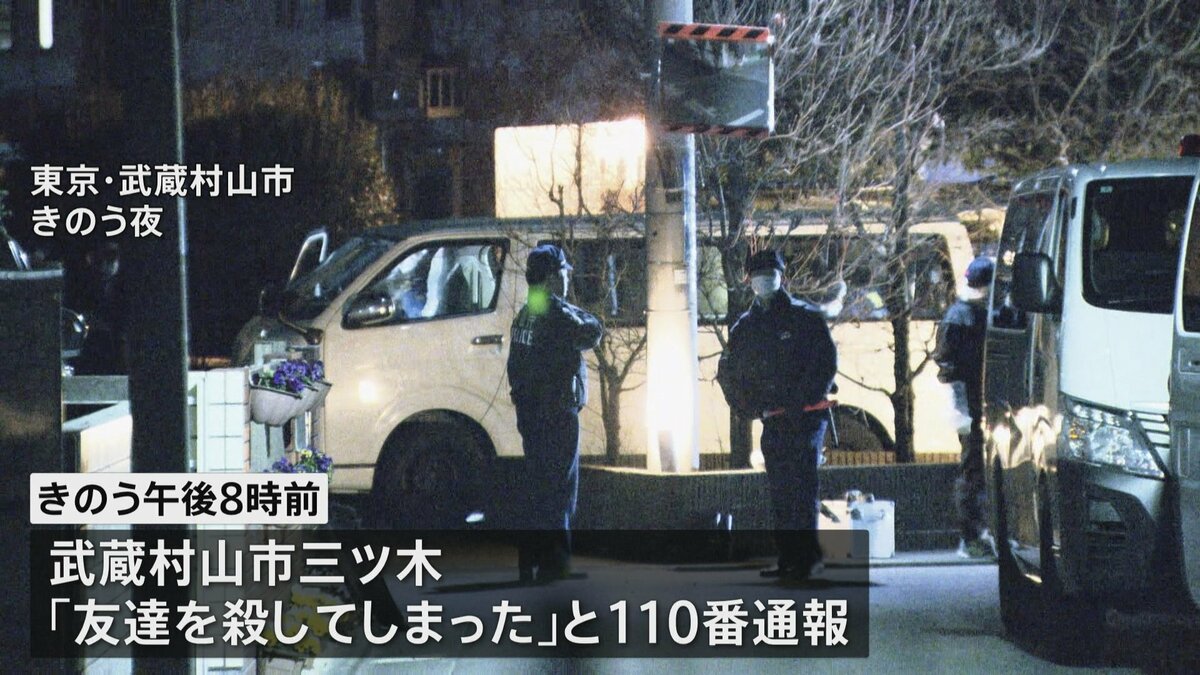
Tokyo — A 26-year-old man was arrested on suspicion of abandoning a body after he phoned Japan’s 110 emergency line and reported that he had “killed a friend following an argument,” according to the Tokyo Metropolitan Police Department (MPD). Officers responding around 8 p.m. on February 20 discovered the body of a man in his 20s inside a car parked at an apartment lot in Musashimurayama City, western Tokyo. The arrest was made on February 21 by the MPD’s Higashi-Yamato Police Station, and investigators say they are also examining the case as a potential homicide.
What police say happened
According to investigators, the caller and the victim are believed to have been sharing a room at the same apartment while working locally. Prior to the arrest, the caller reportedly told officers during voluntary questioning that a work-related criticism had escalated into a heated dispute, during which he stabbed the other man with a kitchen knife. After the arrest, police say he declined to make further statements. Authorities have not released the victim’s identity pending notification of next of kin.
Detectives believe the body may have been moved from the apartment to the vehicle around February 10. The victim was reportedly found face-down inside the car with a wound to the back. As of Thursday, the man who called police remains under arrest on suspicion of abandoning a body, while the MPD continues to gather evidence and interview witnesses as it considers a murder charge.
The legal context: why “abandoning a body” is often the first charge
In Japan, police commonly begin with the “abandonment of a corpse” charge (a distinct offense under the Penal Code) when a deceased person is concealed or left in a non-designated location. This allows investigators to secure custody of a suspect while forensics, autopsy results, and statements are analyzed to determine whether additional charges, including murder, are warranted. Under Japan’s legal process, suspects are typically referred to prosecutors following arrest, and further detention requires court approval. Authorities stress that all suspects are presumed innocent until proven guilty in court.
Safety in Japan—and why this case stands out
While this incident is deeply troubling, it is noteworthy in part because such violent cases remain relatively rare in Japan, which consistently records one of the world’s lowest homicide rates. Tokyo in particular is regarded internationally for its strong community policing and rapid investigative responses. The swift discovery following the 110 call underscores both the effectiveness of Japan’s emergency system and the diligence with which the MPD handles serious incidents.
Where it happened: western Tokyo’s Musashimurayama
Musashimurayama City lies in western Tokyo, a largely residential area with quiet neighborhoods and commuter links to central districts. Police units there coordinate closely with nearby stations to maintain a visible presence and respond to incidents across the metropolitan area. The Higashi-Yamato Police Station leads investigations in this part of Tokyo, working with forensic teams and prosecutors when major cases arise.
What residents and foreign readers should know
Japan’s 110 line is the nationwide number for police emergencies. Callers are encouraged to provide their location, the nature of the incident, and any immediate safety risks. In many parts of Japan, operators can arrange interpretation services to assist non-Japanese speakers. For non-emergency matters, local police consultation lines and community police boxes (koban) offer guidance and support.
Looking ahead
As the investigation progresses, authorities will rely on forensic analysis, timelines, and corroborating testimony to determine the exact sequence of events. Further updates are expected once autopsy findings are complete and prosecutors decide on potential additional charges. Japan’s strong rule of law and meticulous investigative standards aim to bring clarity to difficult cases like this, while maintaining the country’s high standards of public safety.