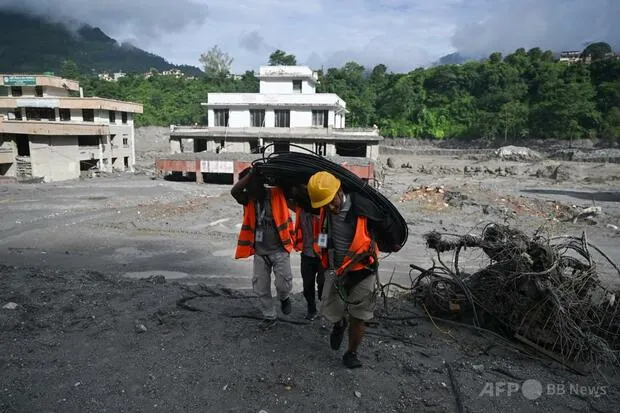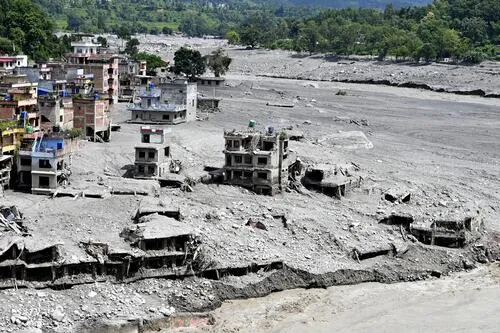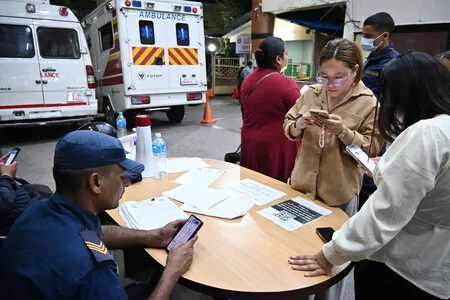
Kathmandu—Hospitals across Nepal’s capital filled with the injured and the bereaved after powerful debris flows tore through communities in central districts, sending families on desperate searches for missing relatives. Outside emergency rooms and mortuaries, notice boards displayed photographs and hastily compiled lists. Many arrived with only names, memories, and fading hope. “Everything was swept away,” one relative told reporters, fearing recovery would be nearly impossible, according to accounts gathered by Jiji Press in Kathmandu.
Families trace faint clues through crowded wards
At one hospital where more than 20 bodies were being kept, 55-year-old Sarada Praja sifted through images and asked staff for any trace of her pregnant daughter, 27, and son-in-law, 28, a police officer transferred three months ago to Mailung in Rasuwa District. The entrance was lined with distressing photographs, including those of young children—grim reminders of the debris flow’s sudden force. Praja, who cannot read or write, explained how official lists offered little help. She depended instead on people’s recollections and pictures shared on walls and phones. “If not for the disaster, I was supposed to see my daughter today,” she said, her voice unsteady.
“Like a tsunami”: A survivor’s account
In another ward, former police officer Ramesh Dangol, 56, from neighboring Nuwakot District, described the moment the earth gave way. “It was like a tsunami,” he said of the torrent of rock and mud that bore down on homes. He and his immediate family escaped in time, but seven of nine members of his sister’s household remain unreachable. For many, blocked roads, damaged bridges, and power cuts have hampered both rescue efforts and the simplest act of calling a loved one.
Why landslides turn deadly in Nepal
Nepal’s steep terrain, intense monsoon rains, and expanding settlements on unstable slopes combine to make landslides a recurrent hazard. As climate change intensifies extreme rainfall events across South Asia, slope failures can occur with little warning, often at night. In the absence of robust local early-warning systems and engineered protections, entire hamlets can be hit within minutes. In the aftermath, overwhelmed facilities resort to posting names and photos of the dead and injured—practices that, while vital, can exclude those who cannot read or who have no formal identification documents with them.
Japan’s expertise—and solidarity—matter
Japan, itself no stranger to catastrophic landslides and debris flows, has built world-leading early-warning protocols, hazard mapping, and community evacuation training. Through long-standing partnerships with Nepal—including technical cooperation via the Japan International Cooperation Agency (JICA) and collaborations with Japanese universities and NGOs—Japanese know-how has supported slope disaster risk reduction, from monitoring rainfall thresholds to improving evacuation drills. In the current emergency, such expertise is directly relevant: rapid damage assessment, temporary slope stabilization, and clear public communication can save lives in the crucial first 72 hours.
For Japanese residents, tourists, and climbers in Nepal, the Embassy of Japan in Kathmandu routinely urges close attention to local advisories during the monsoon season and registration with safety services. Japan’s private sector, too, offers technologies—from sensors and drones to geospatial analytics—that can bolster search operations and long-term resilience planning. The broader lesson resonates in Japan as well: investing in community-based preparedness and accessible information—lists, maps, alerts designed for all literacy levels—reduces tragedy when seconds count.
How readers can help
Authorities and humanitarian groups on the ground typically prioritize immediate needs: search and rescue support, emergency medical care, clean water, shelter, and psychosocial assistance for survivors like Praja and Dangol’s families. Those wishing to assist can refer to recognized organizations with a proven presence in Nepal, such as the Nepal Red Cross and international relief agencies. As the situation develops, reliable updates and needs assessments help ensure donations meet urgent gaps. Japan’s deep ties with Nepal—cultural, academic, and humanitarian—underscore a simple message from Tokyo to Kathmandu: you are not alone.
As hospitals in the capital continue to receive victims and anxious relatives, the hardest-hit communities await clearer answers. For many families, a name on a list—or a voice on a working phone line—would be the first step out of limbo.