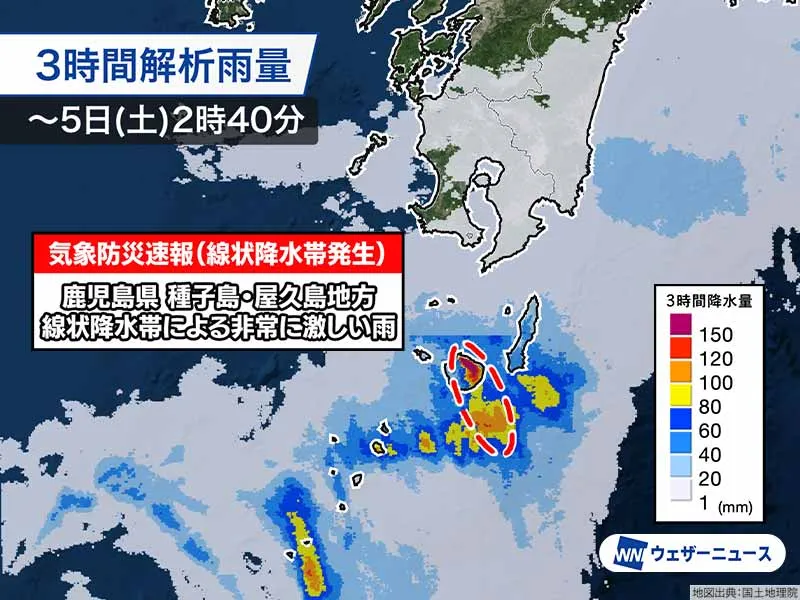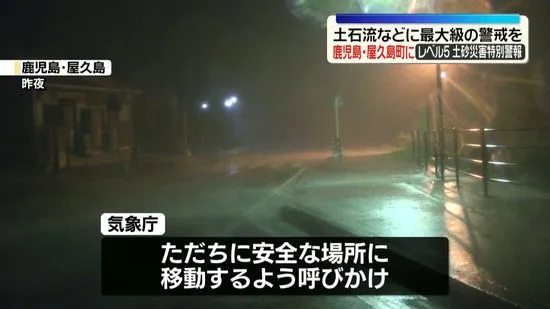
Kagoshima, Japan — Japan’s Meteorological Agency (JMA) has issued a Level 5 Special Landslide Emergency Warning for Yakushima Town in Kagoshima Prefecture after a linear precipitation band unleashed record-breaking rainfall before dawn. The highest tier on Japan’s five-level alert scale, Level 5 signals an immediate, life-threatening situation. “Lives are in danger. Take immediate action to ensure your safety,” JMA Forecast Division Director Takuya Hosomi urged. The Level 5 notice was announced at 5:10 a.m. JST on the 5th. As of 7:00 a.m. JST, the peak of the downpour had temporarily passed, but officials warn the saturated ground could still trigger landslides and debris flows even if rainfall eases.
What Level 5 Means
Japan’s disaster alert scale ranges from Level 1 (awareness) to Level 5 (emergency). A Level 5 Special Warning indicates that a dangerous event is either occurring or imminent, and residents should already be in a safe place or take immediate, last-resort protective actions. For landslide risks, that includes moving away from steep slopes, ravines, and rivers, and relocating to higher, sturdy floors if evacuation is too dangerous. Local governments may also send evacuation information via mobile emergency alerts and community loudspeakers.
Why Yakushima Is Vulnerable
Yakushima—an island south of Kyushu and part of Kagoshima Prefecture—is famed for its ancient cedar forests, dramatic mountains, and status as a UNESCO World Heritage site. Its terrain is steep, and its climate features very high annual rainfall. Those factors heighten landslide risk when intense rain persists. Today’s event was driven by a linear precipitation band (known in Japan as a “senjō-kōsuitai”), a narrow but quasi-stationary corridor of thunderstorms that can dump torrential rain over the same area for hours. In recent years, Japan has expanded real-time monitoring of these rainbands and issues dedicated alerts to help people react faster.
Current Situation and Outlook
According to the JMA, Yakushima experienced a period of record rainfall overnight as the linear rainband formed. While the heaviest burst has subsided for now, the ground has absorbed exceptional amounts of water. That means slopes can fail suddenly, especially where terrain is steep or where soils are already saturated. Authorities emphasize that the danger does not end when the rain lets up; landslides, debris flows, and rapidly rising streams remain possible. Residents and visitors should stay tuned to official updates and avoid nonessential travel in affected areas until warnings are lifted.
Guidance for Residents and Travelers
For anyone on Yakushima or in southern Kagoshima Prefecture today: move to a safe location immediately if you are near steep slopes, riverbanks, or valleys. Do not attempt to cross flooded roads or bridges. If evacuation routes are unsafe, shelter on higher floors of a sturdy building and place as many walls as possible between you and outside slopes. Travelers planning hikes to popular sites—such as the island’s cedar forests—should postpone outings and check with local authorities and accommodation providers before moving. Transport services, including ferries and flights, may be disrupted; verify schedules with operators.
Japan’s Preparedness and Where to Get Reliable Information
Japan is globally recognized for its advanced, transparent disaster-alerting ecosystem. The JMA’s multilingual website (jma.go.jp) and the NHK World-Japan platform provide frequent updates in English. Municipal websites and prefectural channels share evacuation maps and shelter information; hazard maps highlighting landslide-prone areas are widely available online. International residents and visitors can consult embassy advisories and ensure that emergency contact details are on hand. Keeping a small go-bag, portable battery, water, and basic supplies is recommended throughout Japan’s rainy season.
Broader Context
Linear precipitation bands have been linked to several recent severe rain events in Japan. In response, authorities have refined forecasting, introduced targeted “linear rainband information,” and strengthened community-level communication. While no single downpour can be reduced to one cause, Japan’s emphasis on science-driven alerts and community readiness continues to save lives. Today’s Level 5 warning for Yakushima is a reminder that paying attention to official guidance—and acting early—remains the most effective protection.
Officials urge residents and visitors alike: even if the sky brightens, remain vigilant until warnings are lifted. Stay informed, prioritize safety, and follow local instructions. Japan’s robust systems work best when everyone responds quickly and calmly.